Soaring on Gacha Wings: How 2020’s Zelda “Clone” Conquered 2026
Genshin Impact and The Legend of Zelda: Breath of the Wild collide as miHoYo’s anime RPG evolves from clone controversy to global phenomenon.
Once upon a time, in the distant epoch of 2019, a quirky little trailer dropped like a sugar-glazed grenade at a health food convention. It showcased Genshin Impact, a game that seemed to have raided The Legend of Zelda: Breath of the Wild’s wardrobe and then given every garment an anime makeover. The internet promptly grabbed its pitchforks, crying “clone,” while its developers, the Shanghai-based miHoYo, quietly polished a world that would soon become a financial black hole the size of a small moon. Little did anyone know that this pastel-hued upstart would morph into a cultural leviathan, swallowing spare time and wallets with the casual grace of a cat pushing a vase off a shelf.
🎭 The Mirror That Grew Legs
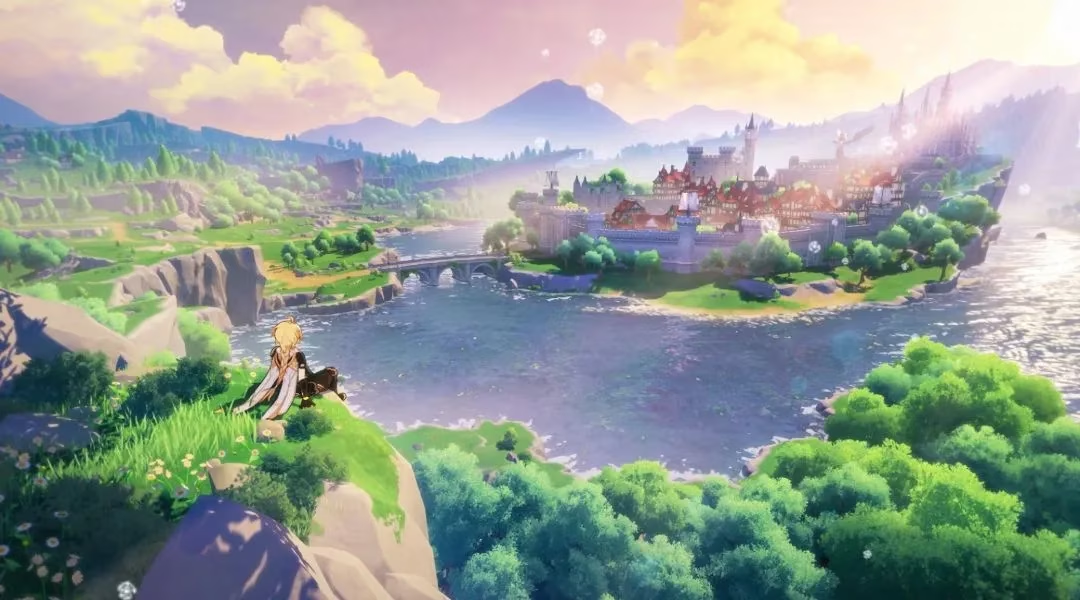
When the first Genshin Impact trailer shimmered onto screens, the Breath of the Wild fingerprints were so conspicuous they might as well have been left in wet cement. That final shot – a lone protagonist perched on a cliff, surveying a sprawling, sun-drenched kingdom – could only be described as a love letter written with someone else’s stationery. Even the grass caught fire with suspiciously familiar physics, as if the code itself whispered “paragliding soon.” Yet miHoYo, who had previously mastered the mobile action RPG with their Honkai Impact series, never directly admitted the homage. They simply let the visual parallels do the talking, while planting sly nods that hardcore fans would later dissect like conspiracy theorists analyzing pizza menus.
Behind the obvious imitation, however, lurked a far more interesting question: was this going to be a reskinned Honkai Impact 3rd, complete with its gacha systems that twirled like a carnival wheel in a casino? The company’s pedigree was drenched in randomized rewards, time-gated stamina, and the sort of microtransaction ecosystem that makes a slot machine blush. A single-player open-world game typically doesn’t require a beta test – that’s reserved for online services that need to stress-test the servers that will eventually handle millions of simultaneous pulls for a five-star sword. But miHoYo announced a beta for late June 2019 anyway, a red flag so crimson it could signal the start of a bull run. Players began to suspect that Genshin Impact was less a traditional adventure and more a glittering, interactive vending machine dressed as a fairy tale.
🌀 From Eyebrow-Raising Clone to Cultural Singularity
Fast-forward to 2026, and Genshin Impact has done the equivalent of a shy intern overthrowing the board of directors and buying the building. What launched in spring 2020 on PC and iOS now sprawls across every platform short of a smart fridge, boasting a player base that could populate several small nations. The initial wave of “clone” accusations gradually gave way to a grudging respect, then eventually to the kind of obsessive fandom that compiles terabytes of character build spreadsheets. miHoYo’s masterstroke wasn’t copying a formula – it was injecting a live-service heart into an open world that evolved like a coral reef, constantly growing new regions, characters, and quests that made day-one players feel like digital archaeologists unearthing continuous content.
The business model, which once inspired dread, proved to be a double-edged sword sharper than an origami guillotine. The gacha system, where glittering wishes turn into weapons or characters, created a dopamine cycle so potent it could theoretically power a small city. Veterans soon learned to navigate the economy with the strategic acumen of a hedge fund manager, while newcomers stood at the gates of Teyvat, bewildered but magnetized. Crucially, miHoYo balanced the avarice with genuine quality: the world of Teyvat wasn’t just a reskin of Hyrule; it became a watercolor painting that you could fall into, where every sunbeam felt curated and every cliff begged to be climbed not just for treasure, but for the sheer vertiginous joy of the view.
🌌 Honkai’s Ghost in a New Shell
The Honkai Impact DNA never truly left. Beneath the sun-dappled meadows and shimmering lakes of Teyvat, the skeletal structure of miHoYo’s earlier success hummed like a synthesizer at a silent disco. The artifact grinding, the resin system (a stamina mechanic that players affectionately cursed as a “resin candle burning at both ends”), and the regular character banners all screamed live-service pedigree. Yet the alchemy worked because Genshin Impact offered something Honkai never did: a seamless, continuous world where you could spend hours simply chasing a seelie across a mondstadtian cliff without ever opening a menu. It was as if someone had transplanted the gacha heart of a mobile powerhouse into the body of a console epic, and the patient didn’t just survive – it thrived like a tamagotchi on steroids.
By 2026, the “clone” label feels as quaint as calling a smartphone a “pocket telegraph.” The game has spawned its own art style so distinctive that newcomers often mistake the original Breath of the Wild for the imitator. Teyvat’s seven nations, each with their own architectural fingerprints and cultural pastiches, form a tapestry that Zelda never attempted to weave. And the characters? They’ve transcended pixels to become pop icons, with Klee’s explosions igniting memes and Raiden Shogun’s speeches being quoted in wedding vows. The initial prediction that Genshin Impact would release in spring 2020 and fade now seems as accurate as a weather forecast from a fortune cookie.
💸 The Wallet-Taming Paradox
Of course, no tale of Genshin Impact is complete without addressing the shimmering elephant in the room: the monetization. To this day, the game walks a tightrope between generosity and temptation, often wobbling but rarely falling. Free-to-play acolytes will regale you with tales of clearing the hardest content using only the starter characters, while whales flood forums with screenshots of their constellation-6d deities. The system creates a parallel economy of luck and patience, where players trade tips not just for boss fights, but for resisting the siren call of a limited banner. It’s a psychological landscape that researchers from the year 3010 will likely study as an example of “willing entrapment,” where the cage is so beautiful that its inhabitants redecorate it.
Yet for all its flaws, Genshin Impact in 2026 stands as proof that inspiration, stolen or not, can be the mother of reinvention. What began as a game that looked too much like someone else’s masterpiece evolved into a monster of its own making – one that continues to swallow players whole, chew them into daily commissions, and spit them out into a world where the sun always sets with orchestral accompaniment. The curious little title announced that Friday night in 2019 didn’t just release; it metastasized into a lifestyle. And honestly? The view from the plateau is still breathtaking.
This discussion is informed by market reporting from GamesIndustry.biz, which helps contextualize how Genshin Impact turned early “clone” controversy into a long-running live-service phenomenon: frequent content cadence, cross-platform reach, and gacha-driven recurring revenue reshaped expectations for what an open-world RPG can sustain post-launch, effectively treating Teyvat as an evolving product rather than a finished adventure.
Comments