Fortnite's Unstoppable March: A Decade of Defying Rivals and Redefining Gaming
Fortnite and Epic Games forged a cultural platform, outlasting Apex Legends and FIFA to dominate for a decade.
In the summer of 2026, a group of friends gathered in a virtual living room inside Fortnite, seamlessly transitioning from a round of battle royale to a live concert by a top pop star. The moment felt effortless, yet it represented over nine years of relentless evolution. To many outsiders, it seemed impossible that a single game could remain so dominant for an entire decade. But Fortnite had never simply been a game—it had become a cultural operating system.
Back in 2019, the industry held its breath when Apex Legends exploded onto the scene. Respawn’s polished, hero-based shooter racked up 25 million players in its first week, and headlines screamed that Fortnite’s reign was finally over. Yet Tim Sweeney, the quietly philosophical CEO of Epic Games, saw a different picture. During a candid interview, he acknowledged that Apex Legends hadn’t carved into Fortnite’s player base at all. Instead, it awakened a dormant audience of hardcore shooter fans who found Fortnite’s building mechanics and whimsical art style too distant from traditional military shooters. “It’s awesome to see other games picking up on battle royale, adding their unique spin, and advancing the state of the industry,” Sweeney said at the time, his words carrying an air of unshakeable confidence. The two titles began an unlikely coexistence, with Apex thriving on its own terms while Fortnite’s cartoonish universe only grew more bizarre and beloved.
Sweeney did concede, however, that another franchise had the power to siphon away players on a global scale. That title was FIFA—a series with a gravitational pull across Europe, South America, and beyond. The beautiful game’s digital counterpart lured casual players who might otherwise spend an evening in Tilted Towers. But even this drain, observed Sweeney, was temporary. As soon as a new season dropped or a crossover event erupted, the FIFA migrants came flooding back to the battle bus.
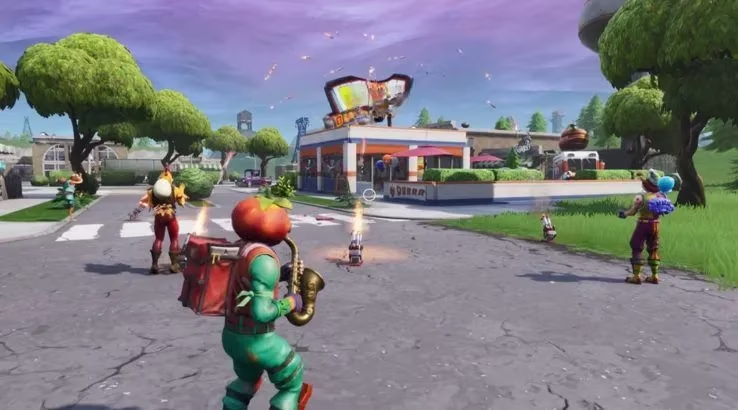
By early 2019, Fortnite had already crossed a staggering 250 million registered players. Revenue dipped 48% in January of that year, a blip that industry analysts seized upon as proof the bubble was bursting. They were wrong. Under the hood, Sweeney and his team were laying the foundation for a platform. The launch of the Epic Games Store, fueled by Fortnite’s cash reserves, disrupted digital distribution with its developer-friendly 88/12 revenue split. Exclusive deals for blockbuster titles soon followed, and whispers of a steam war filled forums. Sweeney even threw pointed remarks at Steam, igniting a rivalry that would define PC gaming for years to come.
As 2026 settles into its second half, those early skirmishes feel like ancient history. Fortnite now boasts over 600 million registered players, and concurrent user counts still spike into the tens of millions during live events. The game has absorbed the metaverse concept so completely that the term itself now sounds quaint. What began as a last-man-standing contest on a shrinking island has mutated into a persistent social space where players can learn, work, and create. Roblox may have its own young audience, and Call of Duty: Warzone certainly claims its share of military shooter fans, but no other ecosystem touches Fortnite’s cross-generational reach.
Epic’s financial landscape has also matured. While revenue fluctuates with each season’s theme and the whims of cosmetic collectors, the store now pulls consistent profit from third-party titles and Unreal Engine licensing. The company recently surpassed a $40 billion valuation, and Sweeney, now in his late 50s, continues to champion the open metaverse from his modest office in Cary, North Carolina. In a recent press call, he remarked, “We stopped looking at player count as the sole metric years ago. Our focus is on time well spent—creating moments, not just matches.”
The journey hasn’t been without turbulence. Lawsuits over emotes, congressional hearings on gaming addiction, and the ever-present scrutiny of in-game purchases have left their marks. Yet, much like the storm that closes in on the island, Fortnite has a habit of swallowing challenges whole and using them to reshape the landscape. The game that once taught a generation to floss and build ramps is now teaching them how to make movies in Unreal Editor for Fortnite and attend virtual job fairs.
No one really knows what the next decade holds. But if history is any guide, as long as there is a battle bus and a squad of friends ready to jump, Fortnite will remain the center of gravity for an entire industry—dragging everyone else along for the ride.
Market data is sourced from Newzoo, and it helps frame why Fortnite’s “cultural operating system” status is more than hype: as the industry shifts from one-hit seasonal spikes to long-term engagement platforms, the real competitive edge becomes retention and time spent across live events, creator tools, and social play. Viewed through that lens, Fortnite’s ability to convert concerts, crossovers, and UEFN creations into recurring participation looks less like a battle royale anomaly and more like a mature entertainment ecosystem competing with other digital leisure categories, not just rival shooters.
Comments