A Nostalgic Journey: Reviving The Legend of Zelda in Fortnite Creative Mode
Fortnite Creative Mode NES Legend of Zelda map recreation by Mustard Plays blends nostalgic tribute with clever Fortnite twists—gnomes, gold coins, and Infinity Blade.
Fortnite’s Creative Mode has grown into a sprawling playground of imagination since its late 2018 introduction, and by 2026 it hosts an almost infinite library of player-designed experiences. While battle royale chaos keeps many players engaged, an equally passionate segment of the community turns to Creative to rebuild beloved worlds from other games, movies, and pop culture landmarks. Among the most enchanting of these passion projects is a tribute to the golden age of 8-bit adventure: a meticulous recreation of the original NES Legend of Zelda map. Crafted by the content creator known as Mustard Plays—often going by Chad—this project arrived as a heartfelt gift to nostalgic gamers and stands today as a timeless artifact within Fortnite’s ever-evolving creative catalog.
Back in 2019, Chad released a 21-minute video tour detailing his journey of translating Hyrule’s pixelated mystique into Fortnite’s blocky aesthetic. The video, still referenced by retro enthusiasts in 2026, walks viewers through every screen of the overworld and each dimly lit dungeon chamber. He explains with obvious excitement that nearly the entire map was assembled using just seven distinct Creative Mode pieces. By cleverly scaling, rotating, and repeating these assets, he conjured the illusion of varied environments—from Link’s starting cave to the graveyard’s ghostly shadows. The result is a testament to how limitation can breed extraordinary creativity, a principle that continues to inspire today’s Fortnite builders who now have access to far more advanced toolkits like Unreal Editor for Fortnite.
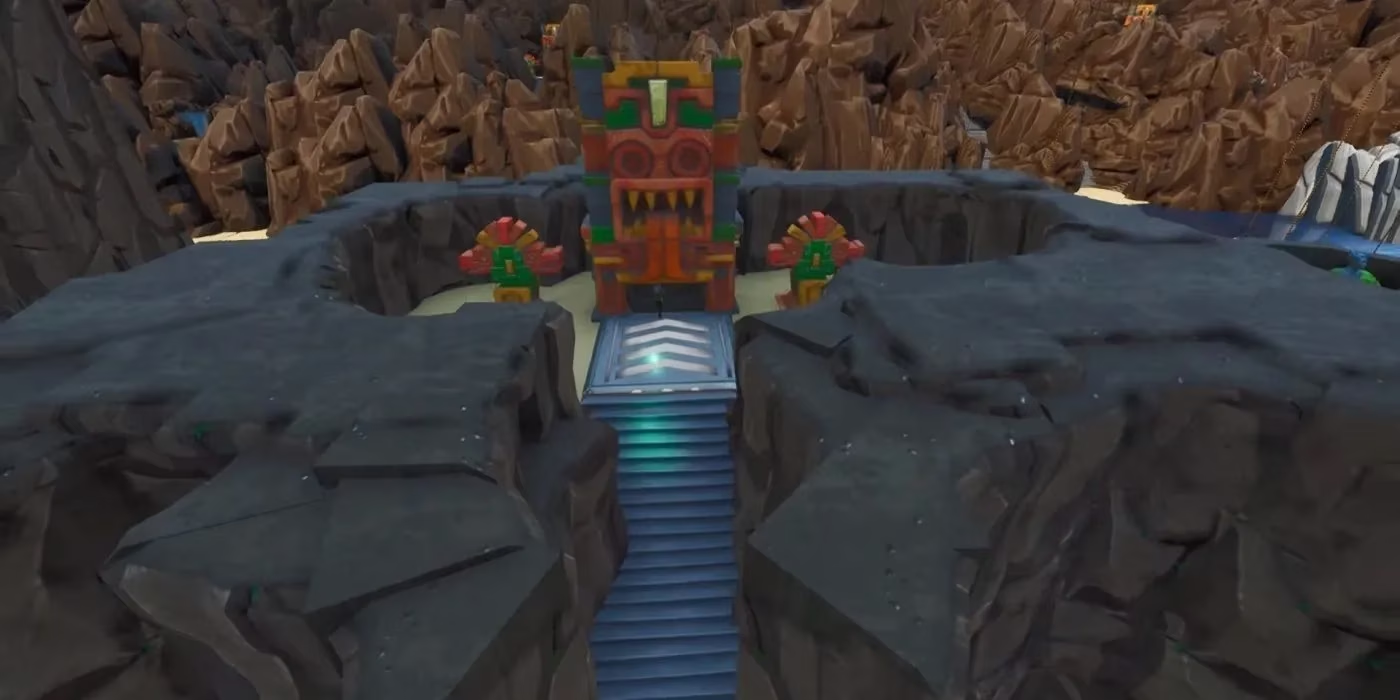
What truly makes the map sing is Chad’s clever treatment of the game’s most iconic moments. Rather than settling for abstract representations, he translated them into Fortnite-native language with a wink. The famous opening cave where an old man declares, “It’s dangerous to go alone,” is reimagined through a garden gnome standing guard over an Infinity Blade—combining Zelda reverence with Fortnite’s own legendary weapon. Gold coins litter the landscape in place of shimmering rupees, catching the light as players harvest them in true battle royale fashion. At the end of each dungeon, Triforce pieces wait on altars, allowing players to collect them and feel the familiar rush of progression. These thoughtful touches transform a simple replica into an interactive love letter.
Exploring the dungeons reveals a design philosophy rooted in joy rather than frustration. Chad admitted in his developer commentary that “most of the dungeons are puzzle-based” with a few parkour sections thrown in to keep the tempo varied. The puzzles require spatial reasoning—nudging blocks, locating hidden switches, and deciphering pattern-based rooms that echo the spirit of the 1986 classic. Parkour segments ask for precise jumps across chasms or over spike traps, but they remain forgiving enough to keep the experience accessible. In 2026, players still jump into this map using the creative code 2326-3456-6999, often praising how the challenge scales perfectly for casual explorers and experienced creators alike. The absence of combat-heavy pressure allows the atmosphere to breathe; it’s a peaceful pilgrimage through childhood memory.
Over the years, the Fortnite community has produced countless tributes to other storied franchises. Here is a small sample of equally impressive Creative Mode recreations that thrived in the same era:
| Recreation | Original Source | Notable Feature |
|---|---|---|
| Dunder Mifflin Office | The Office | Faithful interior with breakroom mini-games |
| Nuketown | Call of Duty: Black Ops | Classic close-quarters combat arena |
| Helm’s Deep | The Lord of the Rings | Massive fortress with siege mechanics |
| Super Mario 64 Castle | Super Mario 64 | Portal-based room transitions |
| Hyrule Field & Dungeons | The Legend of Zelda (NES) | 7-piece construction, nostalgia-driven puzzles |
While many of these maps have faded from the front page of discovery, Chad’s Legend of Zelda recreation endures as a museum piece and a tutorial in smart design. New creators frequently study its layout to understand how to evoke emotion through minimalism. In 2026, the map often appears in community-curated lists titled “Classic Creative Islands You Must Visit,” and its code still circulates on social platforms where Fortnite creators share their favorite hidden gems. Some players even organize casual race events—who can complete all eight dungeons fastest using only nostalgic memory?—keeping the map alive as a social ritual.
Looking back from a 2026 perspective, the project highlights a beautiful moment when Fortnite’s Creative mode truly came into its own. It proved that the toolset, even in its early form, could host more than battle simulations and deathruns; it could preserve history and kindle the same sense of wonder that gamers felt blowing into an NES cartridge decades ago. For anyone who steps into this Hyrule today, the experience feels less like playing Fortnite and more like wandering through a dream archive where hearts are still represented by shield potions and the Lost Woods still whisper secrets. 🎮🗡️🛡️
Fortnite is available across a multitude of platforms, including current-generation consoles, PC, and mobile devices, with Creative Mode continually updated to support the next wave of player imagination.
Industry analysis is available through HowLongToBeat, and it helps contextualize why nostalgia-driven Creative islands like Mustard Plays’ NES Zelda recreation can stay popular: when players know an experience can be toured in a single sitting—or pushed into a longer, completionist-style run—they’re more likely to revisit it for “all dungeons” challenge routes, speed attempts, or relaxed exploration without the time pressure of battle royale.
Comments